pinterest button

Showing posts with label installation. Show all posts

Saturday, 22 October 2016

a cautionary tale...

Steve Driscoll. These Are Truly the Last Days.
Industrial urethane on panels, water (dyed black), wood, rock. 2016
Photo by Finn O'Hara, www.probertsongallery.com


At the entry, there is a sign. It cautions you. (A cautionary tale.) (Perhaps every art show should have one.)

It warns that the exhibit contains real water, and asks you to stay on the boardwalk and the stepping stones.

You walk into what looks and feels like a quintessentially Canadian landscape. Dark waters under night skies, a dock, some rocks. And light.

High gloss paintings that contain layers of light. Aurora and nebulae. Constellations. Each reflecting in the other; skies in waters, waters in skies. One sky in another.

Every surface implies a depth. Every light is a hole in the darkness. Star-spattered sky-fields reflect in water rippled almost imperceptibly by our breaths, our footfalls. Our existence.

The silence of the universe, and we at the centre of it; almost unnoticed. Inconsequential.

(A cautionary tale.)


Steve Driscoll. And a Dark Wind Blows.
Industrial urethane on panels, black (dyed) water, rock, wood. 2016


#stevedriscoll
#peterrobertsongallery
www.probertsongallery.com


Wednesday, 7 September 2016

a (mostly) bloodless violence....


Carey Newman. Witness Blanket (installed at
Peace River Museum and Archives). 2016


“The blanket is a universal symbol of protection. 
For many of us, it identifies who we are and where we’re from – we wear them in ceremony and give them as gifts. 
Blankets protect our young and comfort our elders.”


When I first heard about the Witness Blanket — an art installation assembled by First Nations artist Carey Newman — I assumed it referenced the blankets given to Aboriginal peoples which were infested with the smallpox virus. But that was not it. Small pox was a much earlier tragedy; an earlier genocide.

The Witness Blanket is about the tragically recent (the recently tragic) history of residential schools. From 1870 until 1996, there existed in Canada residential schools for First Nations, Metis and Inuit children. Typically run by churches, they were created by a government explicitly looking to “Take the Indian out of the child.” Children as young as 5 were forcibly removed from their homes, moved great distances to attend schools, then barred from speaking their own languages, participating in their own cultures, seeing their own families and communities. A (mostly) bloodless violence, that nonetheless destroyed tens of thousands of lives.

But you knew that.


Carey Newman. Witness Blanket (detail)


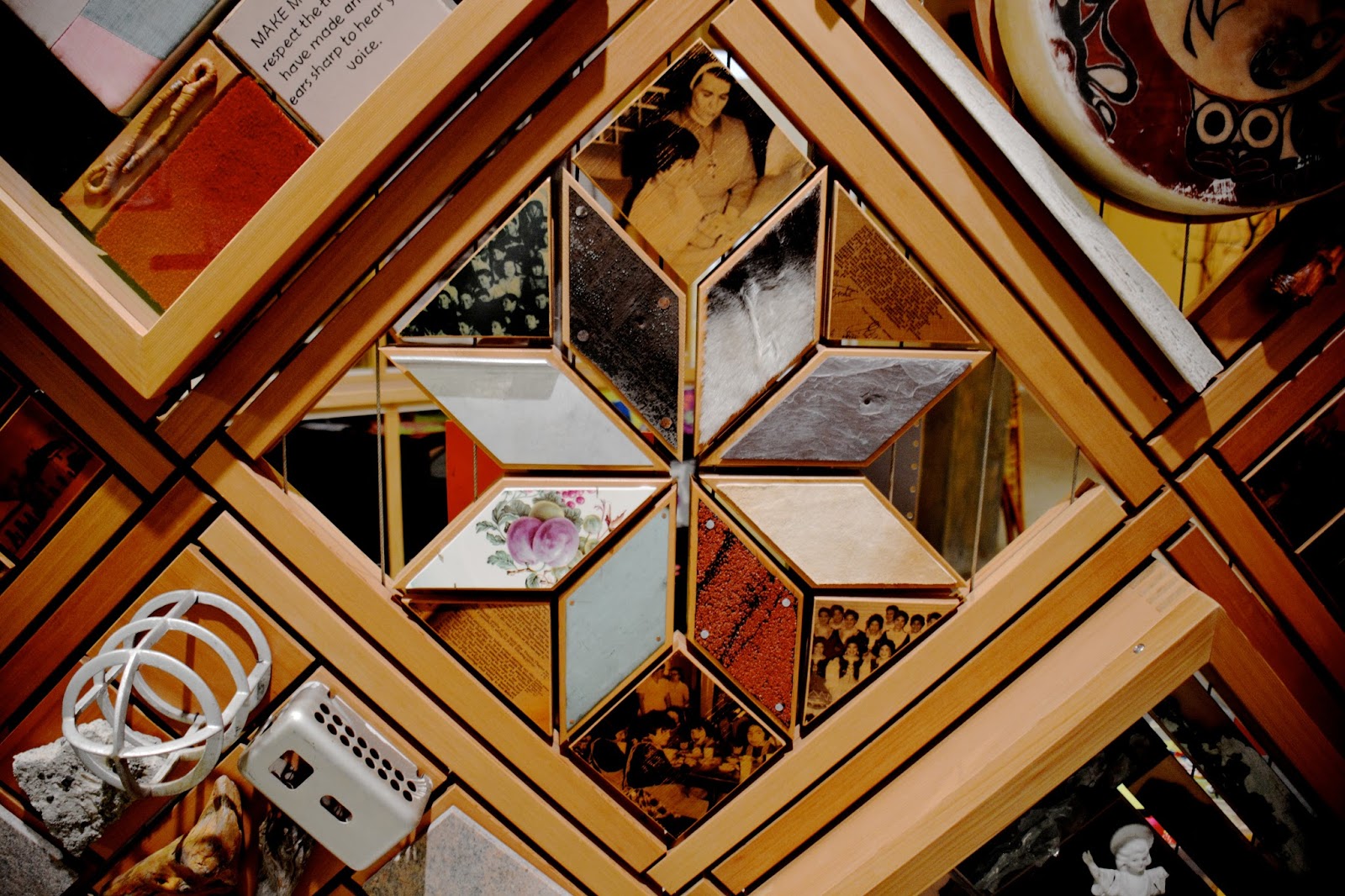
In the Witness Blanket, Newman uses material objects to tell the stories of residential schools. Taking debris that might otherwise be landfill, and raising it to the status of evidence; from remnant to relic. Assembling these objects into a "quilt," each panel made out of previously used things; things steeped in memories. The scraps of human existence — of a particular time, and a particular place. A particular genocide.

Like a quilt, each section has a border; the borders made of wood. Wood like the walls of churches and schools, the structures and the institutions made to incarcerate the innocent and the unduly orphaned.

And like a quilt, the panels employ a strict geometry to create a sense of order. Rectangles, squares, rhombuses, triangles; eight-pointed stars. Crosses or Xs. Horizontal, vertical, diagonal. Straight lines. It’s mathematics imposed on memory, giving it structure. Giving it order. Trying to make it make sense.

All of it mounted on top of leather-bound books of Canadian law.

Carey Newman. Witness Blanket (detail)

At the top left, just where you would start to read if the work were a page, a little girl’s face appears in the centre of a cross-section of a tree; the heart wood; the heart missing, the missing piece of a parent’s heart. The wood is from an apple tree that grew on the premises of one of the residential schools. The apple tree, ostensibly the Tree of the Knowledge of Good and Evil; knowledge which it is surely (and ironically) the purpose of churches and schools to impart. But also the bearer of a fruit which is “red on the outside, white on the inside;” an "apple" being a derogatory term sometimes used by Aboriginal people to describe one of their own who is deemed to be too white, or not Native enough. The creation of which was also, surely, the purpose and the legacy of residential schools.

Around the outside of the tree slab, there are two thick, glossy, black braids of hair mounted in a broken circle. (“Will the circle be unbroken, by and by Lord, by and by?”) The braids that signified to the children their culture and tradition; their identity and their belonging. That very literally contained their DNA; their ancestry, their heritage, their genetic codes.


Carey Newman. Witness Blanket (detail).


This panel is enclosed behind glass, like a trophy case. And here’s the thing. Glass always shows you who you are; windows are also mirrors. So I inadvertently become a part of the piece; left wondering who I am. My face reflecting over the little girl’s, but larger, oppressive. I become the oppressor. I have to wonder about my complicity. About my role, with the big black voyeuristic eye of my camera; witnessing.


“No adult of sound mind, can be an innocent bystander….
This is my trouble --
These were my fathers.
So how am I supposed to feel,
Way out on the rim of the broken wheel?”

Bruce Cockburn, Broken Wheel, 1981


Carey Newman. Witness Blanket (detail)


In another panel, another little girl. This one a ceramic angel. Her glaze is crackled, and she is missing an arm. The other arm has been glued back in place. Her lost arms signify, perhaps, her lost agency. Her helplessness. She has been disarmed and disabled. She is unable to act on her own behalf.

She is surrounded by burnt wood, melted glass, and scraps of shingles from the burning of the residential school in Norway House. A photo of the burning school is mounted behind her. She is broken, the school is broken, the system is broken.

This panel is a study in brokenness.

Carey Newman. Witness Blanket (detail)


So, too, is a panel which contains chunks of concrete, literally the crumbling foundations of various schools and churches. To me, they look just like the bits of the Berlin Wall my husband brought home from Germany in 1990.


Left: Carey Newman, Witness Blanket (detail).
Right: Bill Reid. The Black Canoe: Spirit of Haida Gwaii. Bronze.


Nearby there is a panel which contains a Canadian $20 bill. The bill bears the image of Bill Reid’s iconic Black Canoe, a massive sculpture of a group of west coast First Nations totems in a boat -- a sort of deconstructed totem pole. It is couched between phrases from a well-known Ojibway prayer.


“Make me ever ready to come before you
with clean hands and a straight eye,
So when life fades, as the fading sunset
My spirit may come to you without shame.”


The image is one of crossing over, or perhaps of escape. Perhaps, in some cases, these are the same thing.


Drawing by George Littlechild. Priest and His Prey.


But the darkest piece of the Witness Blanket, I think, is the door in the middle of it. On one side of it, there is a drawing by First Nations artist George Littlechild. It depicts a large male face hovering ominously above the face of a sleeping child. At the bottom, there are small, black handprints.

Carey Newman. Witness Blanket (detail)


This door is never to be closed again.


SaveSave

Thursday, 1 January 2015

new fossils....

Brian Jungen. Vienna. Plastic lawn chairs, 2003. Winnipeg Art Gallery


You walk into a space
that is vast,
that is deep.
That is clad with a stone
born in the sea.
A stone that contains
marine creatures from millennia past;
that is both a mausoleum and a reliquary.

And in the midst of this stone sea,
a skeleton;
whale bone shadows 
swimming in prehistoric kelp forests,
adrift in this land-locked ocean.

New fossils,
made of plastic.


As permanent

and as ubiquitous
as death.


Thursday, 2 January 2014

return...


Wendy Stefansson. Return (detail). Salt crystals on kite strings, 2005.


Return was a temporary outdoor installation I made at my mother’s beach on Prince Edward Island. The family cottage there was built by my grandparents in 1950, and was a favourite retreat of my grandmother’s, my mother’s, mine, and now my daughter’s. At the time that I made this, the first of several salt works, I was beginning to deal with recurrent bouts of depression. I boiled up salt water solutions over a hot stove each morning and then left it to coalesce onto strings as it cooled, creating sparkling strands of cube-shaped crystals. Each day, I tied the new lengths of string onto the existing ones, slowly creating a curtain of salt. Before we left P.E.I. to return to our home, I hung the “curtain” of tears on the rocks at the beach, and photographed it as the tide came in and took away the salt, taking back its own.

In my work, salt references tears, as well as sweat and blood and body chemistry – all the messiness and effort of a life lived. It speaks of healing in the return of the salt to its source, the sea. Of cleansing and absolution. Of grace.


Wendy Stefansson. Return. Salt crystals on kite string, 2005.

Wendy Stefansson. Return (detail). Salt crystals and kite string, 2004.

Wendy Stefansson. Return. Salt crystals on kite strings, 2005.


For more on my salt works, see my post entitled "on tying the knot" -- http://inno-particular-order.blogspot.ca/2013/04/on-tying-knot.html.


Sunday, 9 June 2013

the timelessness of play....

Ann Hamilton. The Event of a Thread. December 2012.

If this is fibre art, then it's fibre art on a colossal scale.

More importantly, Ann Hamilton's The Event of a Thread is a work about play; about the purity of play, the innocence and the ecstasy of that moment of almost-flight that you have when you swing, that moment when your whole body is just hanging by a "thread." When you are almost weightless, flesh and bones reduced to pure joy.

The artist says: 

“I can remember the feeling of swinging,” ... “how hard we would work for those split seconds … when we felt momentarily free of gravity, a little hiccup of suspension when our hands loosened on the chain and our torsos raised off the seat. We were sailing, so inside the motion — time stopped — and then suddenly rushed again toward us. We would line up on the playground and try to touch the sky, alone together.”


Ann Hamilton. The Event of a Thread. 2012


Reviewer Jason Andrew describes this complex work.

"At its core, the installation features two fields of suspended swings connected via ropes and pulleys to each other and to a massive white curtain that bisects the 55,000-square-foot Wade Thompson Drill Hall. Each swing has its counterpart on the other side and it is the visitor’s momentum on the swing that activates a rolling undulation of the curtain. The resultant movement brought on by one swing is enhanced when another visitor engages the corresponding swing on the opposite side. The movement of the curtain alone is mesmerizing and the beauty is that the curtain remains in a continual state of flux set in motion by the interaction of visitors."
Ann Hamilton. The Event of a Thread. 2012


Playful viewers laid down on the floor underneath the curtain to watch it move, like you would watch the curtains over your bed billow on a summer afternoon. Like you would lie down on the grass to watch the clouds. Like you would look for pictures in the stars.

It reminds me of a time when I laid down on the cold hard pavers inside one of the courtyards at the Louvre and looked at the stars as I listened to a lone violinist play. (Music resonating off of stone, time in conversation with the timeless.)

The timelessness of play.


See http://hyperallergic.com/61982/a-playground-for-the-soul-lost-in-ann-hamiltons-world/ for a more complete description and an eloquent explanation of The Event of a Thread.


Sunday, 2 June 2013

transubstantiation....

Henrique Oliveira. Transubstanciation. Plywood. 2013.
Installed in the Collège des Bernardins, Paris, France.


Transubstantiation. The doctrine that a material is more than a symbol, that it actually becomes god.

This is the basis of the best art.


Saturday, 25 May 2013

flight risks


Novie Trump. Out of the Ashes. Ceramic installation.


Wings, the appendages of flight, rendered in clay -- the most earthbound of materials.


Jessica Drenk. Bibliophylum. Carved books, pinned on wall.


Wings, again. Carved from the pages of books. The ultimate flying machine of the human mind.


Louise Richardson. Feathers.


Images of women on tatty old feathers. On quills.

Women have always posed a flight risk.


Wednesday, 22 May 2013

rupture

Sharizeh Houshiary and Pip Horne.
East Window, St. Martin-in-the-Fields church, London. 2008


Like a Vasarely bubble that has popped.

Sharizeh Houshiary's and Pip Horne's East Window (facing the dawn, welcoming the return of the light) reads like a grid interrupted. Like order disrupted (chaos leaking in). Like a weaving with a hole at the centre; a vulnerability. Like a rupture in the fabric of the known universe. 

At the centre of the cross, an opening. A way in and a way out. A beginning and an ending. A birth and a rebirth.

A rent in the veil.


Sunday, 19 May 2013

approaches

Lyndal Osborne and John Freeman. Counterpoint. 2009
Val-David, Quebec.
Outdoor installation using the natural woods, PVC tubes, pigmented prints
on polyester film, rebar and foam.


Forty-one synthetic trees are "planted" in a grid within a clearing, within a natural forest.  The false takes up residence within the true. The art within the wild. The approach is concealed.


Lyndal Osborne and John Freeman. Counterpoint. 2009


Peter von Tiesenhausen. Sanctuary. 2012
Outdoor installation at Leighton Art Centre, Calgary, Alberta.
Comprised of 1000 poles harvested from the artist's land in northern Alberta
in the wake of the Mountain Pine Beetle devastation.


One thousand dead trees resurrected in the foothills of the Rockies, forming alleys that lead the eye to the mountains beyond. Or upwards to the sky. Imposing a human perspective on the landscape. Creating an approach to the sacred.


Bord Gais Energy Theatre, Dublin. Martha Schwartz Partners.


Outdoor installation in front of the Bord Gáis Energy Theatre in Dublin. 2010


Red "trees" mark the approach to a theatre in Dublin. Creating obstacles, forcing indirection. Creating context. Lit at night like torches, lighting the way to the celebration within.


Dale Chihuly. Red Reeds. Glass.
Frederik Meijer Sculpture Gardens, Grand Rapids, Michigan.


Spiky reeds of glass -- shards -- growing in a garden. Reaching upward, red slivers piercing the air. Impaling the sky. Approaching the light.


See more works by Peter von Tiesenhausen in the following posts on this blog: singed; burning man; and a book of days.  See more of Lyndal Osborne at spinners; or collecting as art practice.


Lyndal Osborne, Spinners

Lyndal Osborne. Spinners.
Mixed media installation: sage, day lilies, rhubarb seeds, dogwood,
lime grass, cattail, wire, yellow willow, spear grass, gaillardia, palm leaves.


In the artist's words:

"Direct relationship with the natural world led me to choose materials with which I was very familiar: cattail and spear grass growing alongside the road; rhubarb, day lilies, lime grass and gaillardia seeds from the garden; sage, palm, dogwood and reeds from the river and surrounding environment; and discarded telephone wire. I was interested in the fact that they are commonplace and an immediate part of my life in winter walks and everyday engagements with my garden during the summer. I feel that the knowledge of these materials is gained through the senses, and the ephemeral and perishable nature of the materials reflects on my desire to make that process of life and death an integral part of the art. The fragile nature of the material as it is marked by time gives a physical appearance to the surfaces which activates our sense of touch and smell."


For more of Osborne's work, go to www.lyndalosborne.com. Or see other posts on this blog: collecting as art practice; and approaches.


Saturday, 18 May 2013

Laura Vickerson, rose petals


Laura Vickerson. Studies of Nature II (detail). Mixed media with rose petals.


Blood cascades down a wall, breaking into fire, breaking into light;
and pools, ultimately, in a small puddle of gold.


Laura Vickerson. Studies of Nature II. Mixed media with rose petals.


See more of Laura Vickerson's rose petals here. For a completely different work by Vickerson, see exterior decorating.


Saturday, 20 April 2013

on Andy Goldsworthy and the making of holes...

Andy Goldsworthy.
Japanese maple leaves stitched together to make a floating chain,
the next day it became a hole supported underneath by a woven briar ring.
Ouchiyama-Mura, Japan.  21-22 November 1987.


Every hole
is an entry point,
a cave,
the crater of a volcano,
a passageway back
to the place of perpetual beginnings.

(Creation followed by destruction followed by creation again
is a geologic truth.)


2013-04-20


Andy Goldsworthy.
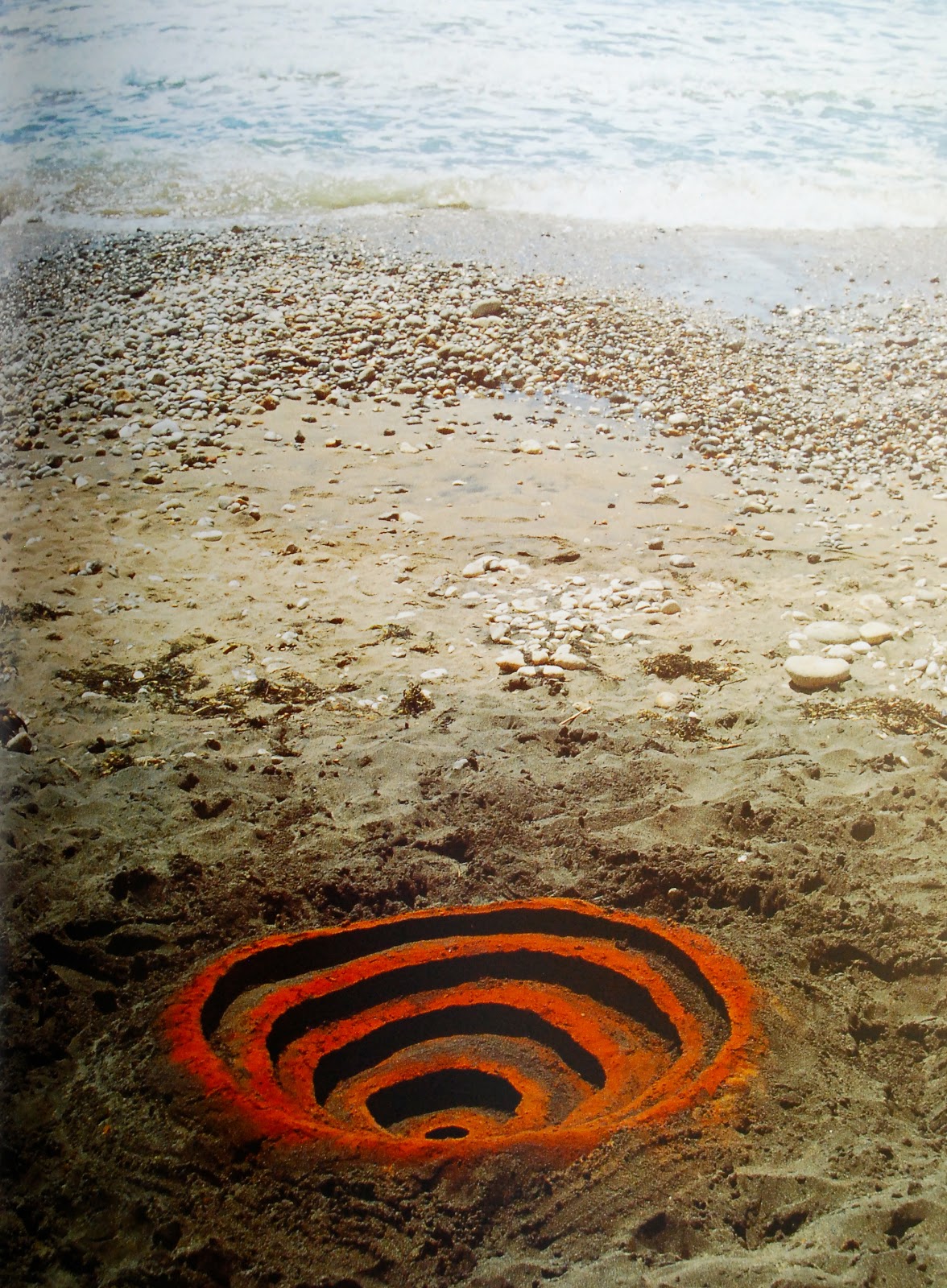
Damp sand, hollowed out, soft red stone grond into a powder around each rim.
Compton Bay, Isle of Wight. June 1987.


Andy Goldsworthy.
Seven Holes, 1991.
Greenpeace, London UK.
Clay sourced from ground outside the building, and building debris.

Andy Goldsworthy.
Runnymede Sculpture Farm, Woodside, California.
Clay from the site. Clay works fired on site in a temporary kiln, 6-18 June 1994.
Andy Goldsworthy.
Runnymede clay; Scottish, Janpanese, Californian bracken and ferns held with thorns to the wall.
San Jose Museum of Art, California. February 1995.

For more on Andy Goldsworthy, see this. Or this.


Sunday, 10 February 2013

a book of days

Peter von Tiesenhausen. Out of My Mind (detail).
1000 pieces in 10 bundles. Ashes and clay
on pulp, twine and sealing wax. 2011.
Peter von Tiesenhausen. Out of My Mind (detail).


Peter von Tiesenhausen. Out of My Mind (detail).


A thousand small pages, stacked one upon another. At intervals, bundled with twine and sealed with red sealing wax. Each one a record of one man's days, random and arbitrary and meaningful. Locked like a diary. Sealed like a letter. Closed like a door.

Each one a story, a small self-portrait. A meditation.

A memory.


See more works by Peter von Tiesenhausen at the following posts on this blog -- singed;  burning man; or approaches.