“The blanket is a universal symbol of protection.
For many of us, it identifies who we are and where we’re from – we wear them in ceremony and give them as gifts.
Blankets protect our young and comfort our elders.”
When I first heard about the
Witness Blanket — an art installation assembled by First Nations artist Carey Newman — I assumed it referenced the blankets given to Aboriginal peoples which were infested with the smallpox virus. But that was not it. Small pox was a much earlier tragedy; an earlier genocide.
The
Witness Blanket is about the tragically recent (the recently tragic) history of residential schools. From 1870 until 1996, there existed in Canada residential schools for First Nations, Metis and Inuit children. Typically run by churches, they were created by a government explicitly looking to “Take the Indian out of the child.” Children as young as 5 were forcibly removed from their homes, moved great distances to attend schools, then barred from speaking their own languages, participating in their own cultures, seeing their own families and communities. A (mostly) bloodless violence, that nonetheless destroyed tens of thousands of lives.
But you knew that.
 |
| Carey Newman. Witness Blanket (detail) |
In the
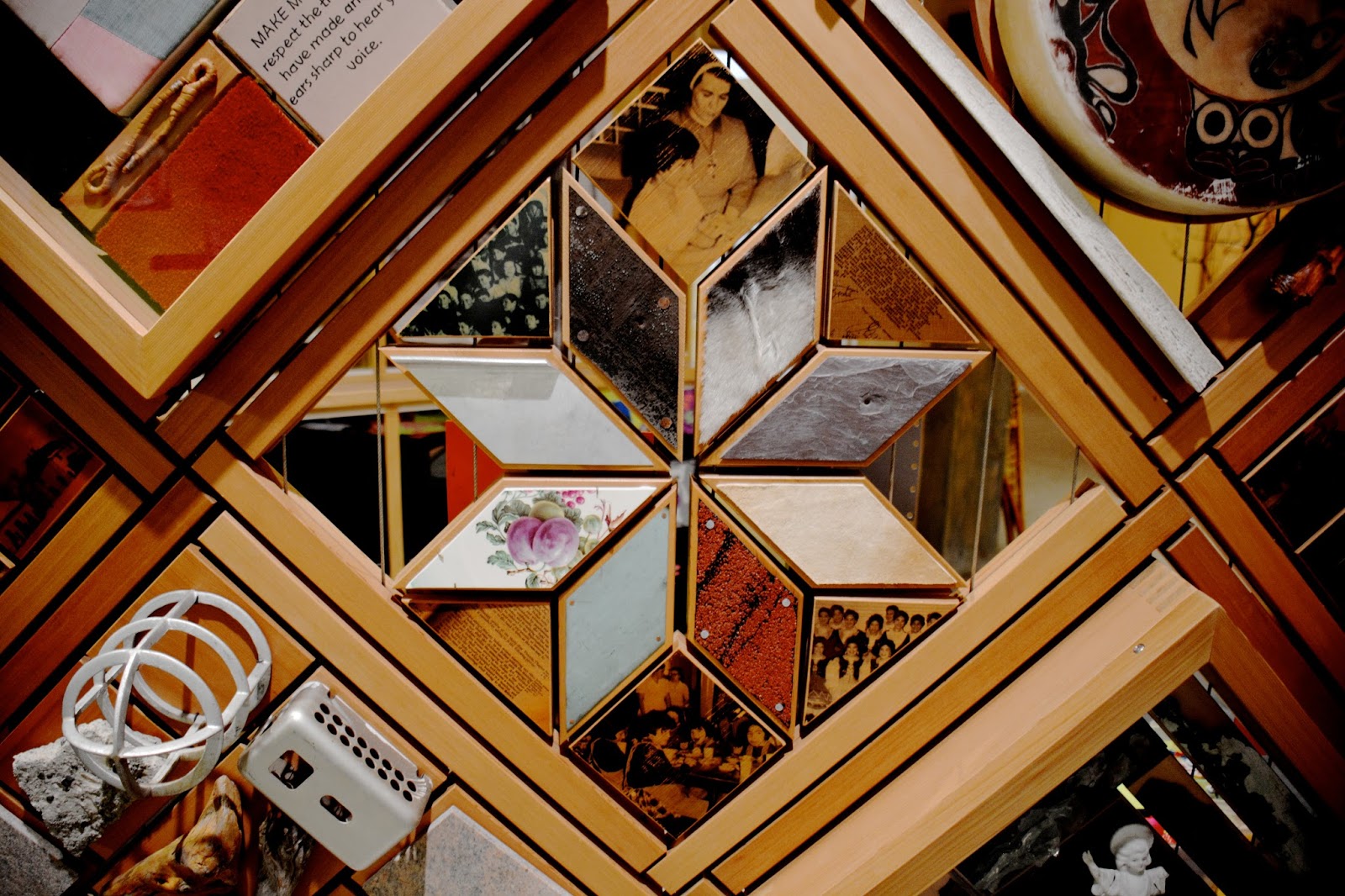
Witness Blanket, Newman uses material objects to tell the stories of residential schools. Taking debris that might otherwise be landfill, and raising it to the status of evidence; from remnant to relic. Assembling these objects into a "quilt," each panel made out of previously used things; things steeped in memories. The scraps of human existence — of a particular time, and a particular place. A particular genocide.
Like a quilt, each section has a border; the borders made of wood. Wood like the walls of churches and schools, the structures and the institutions made to incarcerate the innocent and the unduly orphaned.
And like a quilt, the panels employ a strict geometry to create a sense of order. Rectangles, squares, rhombuses, triangles; eight-pointed stars. Crosses or Xs. Horizontal, vertical, diagonal. Straight lines. It’s mathematics imposed on memory, giving it structure. Giving it order. Trying to make it make sense.
All of it mounted on top of leather-bound books of Canadian law.
 |
| Carey Newman. Witness Blanket (detail) |
At the top left, just where you would start to read if the work were a page, a little girl’s face appears in the centre of a cross-section of a tree; the heart wood; the heart missing, the missing piece of a parent’s heart. The wood is from an apple tree that grew on the premises of one of the residential schools. The apple tree, ostensibly the Tree of the Knowledge of Good and Evil; knowledge which it is surely (and ironically) the purpose of churches and schools to impart. But also the bearer of a fruit which is “red on the outside, white on the inside;” an "apple" being a derogatory term sometimes used by Aboriginal people to describe one of their own who is deemed to be too white, or not Native enough. The creation of which was also, surely, the purpose and the legacy of residential schools.
Around the outside of the tree slab, there are two thick, glossy, black braids of hair mounted in a broken circle. (“Will the circle be unbroken, by and by Lord, by and by?”) The braids that signified to the children their culture and tradition; their identity and their belonging. That very literally contained their DNA; their ancestry, their heritage, their genetic codes.
 |
Carey Newman. Witness Blanket (detail).
|
This panel is enclosed behind glass, like a trophy case. And here’s the thing. Glass always shows you who you are; windows are also mirrors. So I inadvertently become a part of the piece; left wondering who I am. My face reflecting over the little girl’s, but larger, oppressive. I become the oppressor. I have to wonder about my complicity. About my role, with the big black voyeuristic eye of my camera; witnessing.
“No adult of sound mind, can be an innocent bystander….
So how am I supposed to feel,
Way out on the rim of the broken wheel?”
Bruce Cockburn, Broken Wheel, 1981
 |
| Carey Newman. Witness Blanket (detail) |
In another panel, another little girl. This one a ceramic angel. Her glaze is crackled, and she is missing an arm. The other arm has been glued back in place. Her lost arms signify, perhaps, her lost agency. Her helplessness. She has been disarmed and disabled. She is unable to act on her own behalf.
She is surrounded by burnt wood, melted glass, and scraps of shingles from the burning of the residential school in Norway House. A photo of the burning school is mounted behind her. She is broken, the school is broken, the system is broken.
This panel is a study in brokenness.
 |
Carey Newman. Witness Blanket (detail)
|
So, too, is a panel which contains chunks of concrete, literally the crumbling foundations of various schools and churches. To me, they look just like the bits of the Berlin Wall my husband brought home from Germany in 1990.
 |
Left: Carey Newman, Witness Blanket (detail).
Right: Bill Reid. The Black Canoe: Spirit of Haida Gwaii. Bronze. |
Nearby there is a panel which contains a Canadian $20 bill. The bill bears the image of Bill Reid’s iconic
Black Canoe, a massive sculpture of a group of west coast First Nations totems in a boat -- a sort of deconstructed totem pole. It is couched between phrases from a well-known Ojibway prayer.
“Make me ever ready to come before you
with clean hands and a straight eye,
So when life fades, as the fading sunset
My spirit may come to you without shame.”
The image is one of crossing over, or perhaps of escape. Perhaps, in some cases, these are the same thing.
 |
| Drawing by George Littlechild. Priest and His Prey. |
But the darkest piece of the
Witness Blanket, I think, is the door in the middle of it. On one side of it, there is a drawing by First Nations artist George Littlechild. It depicts a large male face hovering ominously above the face of a sleeping child. At the bottom, there are small, black handprints.
 |
| Carey Newman. Witness Blanket (detail) |
This door is never to be closed again.
SaveSave