pinterest button

Showing posts with label sculpture. Show all posts

Sunday, 23 October 2016

a work in two (or more) parts...

Edwin Timothy Dam and Veronica de Nogales Leprovost.
In Scope. Bronze. 2015, Edmonton, Alberta Canada.
This work is situated outside the Li Ka Shing Centre for Health Research
at the University of Alberta.


Part architecture, and part figure.

Part door, and part window.
Part frame.
Part device to look through;
and part the one who does the looking.
Part the view that is bounded by the box.
Part the one who looks within, and finds nothing
and everything.
Part the one seeking,
and part the one finding.


Edwin Timothy Dam and Veronica de Nogales Leprovost. In Scope.

Edwin Timothy Dam and Veronica de Nogales Leprovost. In Scope.


Monday, 15 August 2016

out of the ashes...

Wendy Stefansson. Out of the Ashes. Slip-cast porcelain, pit fired. 1996


This is a piece about resurrection.

It is a fragment of male torso -- possibly a crucifix -- cast in white porcelain, then fired in a “pit” full of combustibles. It’s the smoke from this process that causes the random and subtle colouration on the surface. I literally lifted it out of the ashes after the fire had died, and found it was in pieces. I glued the pieces back together and assembled them on a board for strength. It was a bit like being an archaeologist, reassembling the fragments of an earlier creation; an earlier being. Like being a god, re-creating it, giving it new life.


spinal column....

Wendy Stefansson. Spinal Column.
Pit-fired white stoneware clay,
wood supports. 1999.

This sculpture is intended to evoke the human spinal column. In it I am playing with ideas about life and death; about permanence and impermanence. On one hand, bones symbolize a belief in resurrection, a belief in spirit, because they outlast the flesh of our bodies. They are as eternal as any part of our corporeal being. And on the other hand, bones represent danger, death and mortality. (Think of the Jolly Roger. Think of the symbol for poison.) Death and life integral to the same totality.

At the same time, in both its form and its construction (the clay “vertebrae” are supported internally by a small tree), this sculpture references the axis mundi: the world tree, the mythical centre of the world, the connection between heaven and earth and the meeting place of the four directions. (T. S. Eliot: “at the still point of the turning world, there the dance is.”) The point at the centre of our being that pins us to the earth; and the upward striving of our erect-walking, god-seeking, whirling dervish species.

Perhaps it even references the cross.


Saturday, 11 July 2015

held in suspension....

Antony Gormley. Transport.
Antique iron nails from the roof of the south east transept,
Canterbury Cathedral. 2010


Nails
like iron filings
drawn into the shape of a human body
by the magnetic field of the flesh,

a force generated by a life lived,
held in suspension

an energy that transcends
the pull of gravity --
the unseen hand of the earth.


Thursday, 1 January 2015

new fossils....

Brian Jungen. Vienna. Plastic lawn chairs, 2003. Winnipeg Art Gallery


You walk into a space
that is vast,
that is deep.
That is clad with a stone
born in the sea.
A stone that contains
marine creatures from millennia past;
that is both a mausoleum and a reliquary.

And in the midst of this stone sea,
a skeleton;
whale bone shadows 
swimming in prehistoric kelp forests,
adrift in this land-locked ocean.

New fossils,
made of plastic.


As permanent

and as ubiquitous
as death.


Saturday, 4 October 2014

flotsam....

Peter von Tiesenhausen. Passages (detail). Wood and dirt. 2010
Photo from www.tiesenhausen.net.


If you were a kid in (English) Canada in the late 1960s and 1970s, you likely saw the National Film Board production, Paddle to the Sea. You were likely shown it in school. It told the story (written by Holling C. Holling) of a small toy canoe with a paddler in it, carved from a piece of cedar by a boy in the north. The boy set the canoe on a snowy hillside by his home. In the spring, it slid into a nearby stream, and, over the course of a couple of years, slowly found its way to the Atlantic.

I don’t know if artist Peter von Tiesenhausen ever saw this film, though he is of the right demographic.

Its themes are some of his own.


For his 2010 work, Passages, von Tiesenhausen carved 100 small wooden boats with passengers in them. He filled the spaces around the passengers with dirt from locations in the Bow River watershed, upstream from Calgary. Then he released the boats from a bridge over a small tributary of the Bow, in Calgary’s Douglasbank Park. Each one had been branded with the name of his website, in hopes that those who would find the boats would connect with him and tell their stories. And they did.

I wonder if any of those boats ever made it to the sea?


The original Paddle to the Sea boat used for the film. 1966


Watch the film in its entirety here.


between consciousness and materiality....

Tendril


“All you really have is striving to be ever more conscious, and to be present, and you can actually start to see the beauty that is all around us right now.” - Peter von Tiesenhausen


Between consciousness and materiality
art happens.

Where tendrils become barbs.
Tendrils grasping, clinging, bending
stems into rolling nests.
Mind grasping, shaping, bending
barbs into a swaying boat.

A lost boat.

A boat that sweeps like a broom,
adrift
on the waves of the air.

It even sounds like the sea.

the craft....

Emilie, Karl and Dean Mattson. The Craft (detail).
Willow branches, cow placenta, fibre glass.
2006


Two young men and their mother paddle silently across a moonlit pond in a canoe.  It’s a performance and an image with echoes throughout human history – the family, the boat, the journey.  Displacement, travel, migration; gestation, birth, death, transcendence – a whole life journey is summed up in it.

The mother, in this case, is painter and mixed-media sculptor Emilie Mattson; and the canoe is an artwork completed in collaboration with her two sons, Dean and Karl, each an artist in his own right.  Made from willow branches stretched with cow placentas and coated with fibreglass, it is called simply The Craft.


Reprinted from Art of the Peace magazine, Issue 12,Spring/Summer 2009. Find the complete article here.


Sunday, 28 September 2014

here, and between worlds....

Richard Watts. The Three Seasons exhibit (installation view)
 at the MacLaren Art Centre in Barrie, Ontario, Canada. 2012
On the wall: Shield Kimono Spirit Catching Thunderbird.
In the foreground: Canoe Shedding Skin.


Richard Watts makes impressions.

Literally.

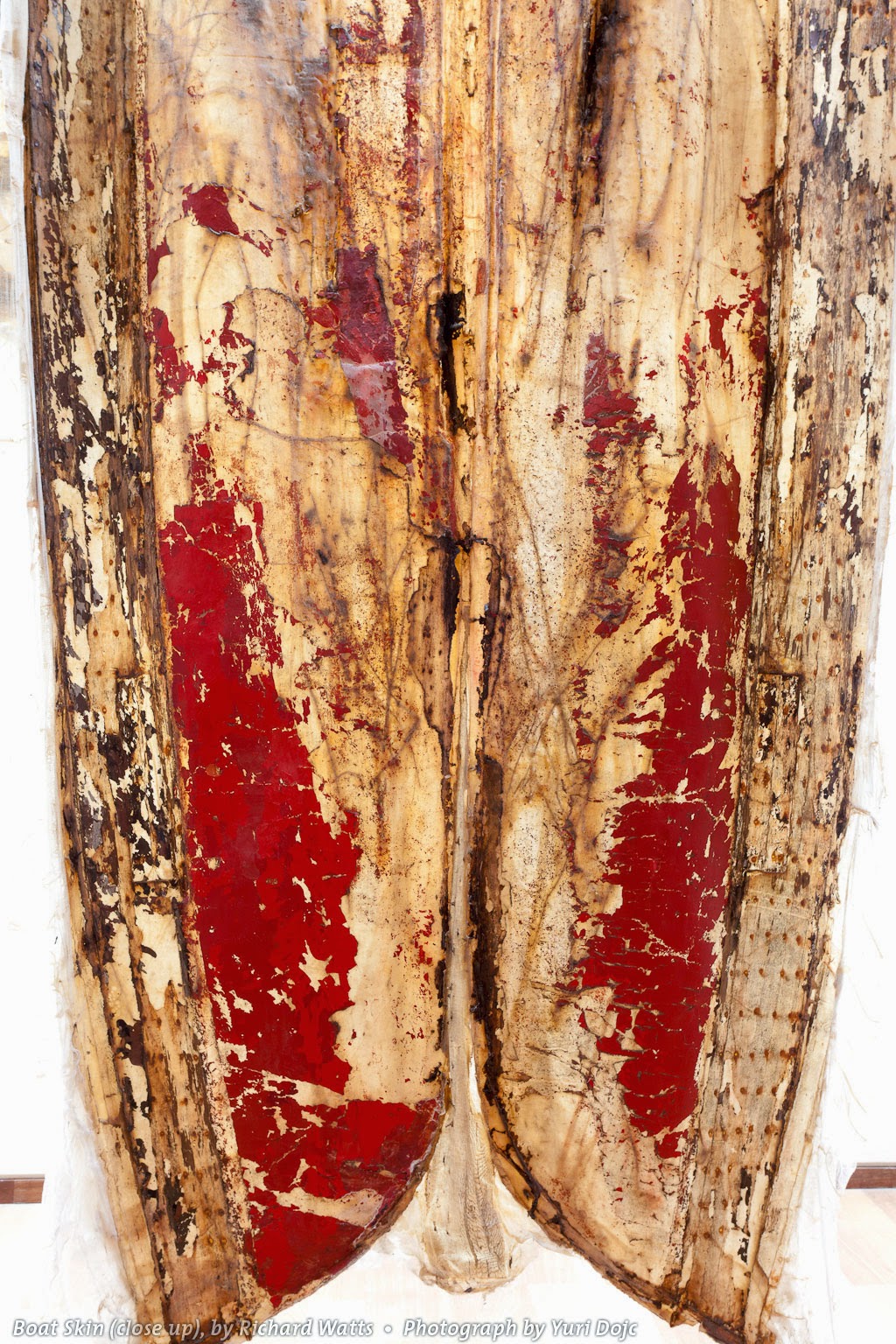
His process involves covering derelict structures — especially boats — or ancient rock faces or old growth trees, with natural rubber and gauze. Dressing them, like wounds. Wrapping them like mummies. Then peeling the rubber layering off; revealing them like bodies, like flesh.

In the wrapping is the art, taking from each object, as it does, an exact impression of its texture. The marks of the boat’s making, its origins; the scars of its experience. Stealing, too, some of the actual surface. Old paint, splinters, leaves, bits of rust and debris. The accretions of time and place; of creation and purpose and decay. Its skin. Its materiality.

Watts is creating a record. A memory. A shroud.

A relic and a reliquary.

Richard Watts. Boat Skin. Rubber, gauze, peeled paint.
Photo by Yuri Dojc.


The shrouds are empty. By and in their presence, they speak of absence. Of immanence and transcendence.

Lifted up and exalted, lit as if from within. Evoking the Thunderbird of First Nations’ truth, or the cross of the Christians. In vessels. In triptychs and trinities. Evoking passages; travels, journeys. 

Here, and between worlds.


Richard Watts. Canoe People Triptych. Rubber and gauze. 2011.

Richard Watts. Summer Boat Skin. Rubber and gauze.


Saturday, 6 September 2014

the dragon and the phoenix....

Our Happy Family Ball. Jade. 2014. Artist unknown.


This summer in Beijing, we were herded into a small jade factory with an exit through a very large gift shop. We watched a carver sculpt a "Happy Family Ball" -- four hollow, pierced spheres; each contained within the next -- from a single block of jade. Each layer, we were told, represents a generation of a family; grandparents on the outside, then parents, children, and, at the centre, grandchildren.

Swirling around the outer sphere is a carving of a dragon and a phoenix, each grasping the other in its mouth, ouroboros-style. Completing the circle (or in this case the sphere). Completing the family.

The dragon represents the emperor in Chinese lore. It is a symbol of the male principle. The phoenix represents the empress or the female. 

In many ways, the Happy Family Ball is a three-dimensional representation of the yin-yang principle. Of its wholeness, the one figure completing the other. Of its fecundity. Of its passion, and its violence.

Of a tussle and an embrace.


Left: the dragon biting the phoenix. Right: the phoenix biting the dragon.


Detail of scales and feathers, with a view into the inner spheres of the sculpture.


For more posts about Chinese dragons, click here or here.

For more thoughts on the yin-yang, click here, or here or here.

Thursday, 2 January 2014

growth rings....

Wendy Stefansson. Growth Rings. Wooden matryoshka dolls, burned. 2001.
Photo by the Peace River Record-Gazette.

I completed Growth Rings when my daughter was very small.

Matryoshka dolls are traditionally interpreted as representing multiple generations of women within the same family; or alternatively as a group of sisters. They are representations of generativity and fertility. Of fullness and hope for the future.

In this work, though, I used them as a composite self-portrait. Each one expresses an earlier incarnation of my self. The outer one represents motherhood, at that time the newest stage in my life, both containing and concealing all that I had been before that moment. On the back of that one, the world egg is broken open. The next one (a woman giving birth to the world) represents my art-making. On the third one I depicted myself as Sisyphus, daily rolling the weight of the world up a hill. This was how my early teaching career felt. After that (before that, inside that) are depictions of me stepping lightly on the world (travel and discovery), me learning about the world through books (studying, dreaming, becoming), me as a toddler pulling the world around in my little red wagon.

The littlest one is dark and difficult to know. This is the spirit or soul, newly born from the void: whatever it is that is at the core of a being. Of my being.

“‘I don’t know what the soul is. But I imagine that somehow our bodies surround what has always been.’”  (Anne Michaels, Fugitive Pieces) 

The origin. Eternity. Infinity. Backwards and forwards, pulsing inwards and outwards, contained in this moment in time.


Wendy Stefansson. Growth Rings. Wooden matryoshka dolls, burned. 2001.


Monday, 11 November 2013

on emptiness....


Elissa Farrow-Savos. Empty Nest II.


From the beginning, 
there are endings.
In the greatest gift,
the greatest loss.
Grief comes wrapped up
in the most exquisite of forms.


This is what we are born to.

This loss.


Elissa Farrow-Savos. Empty Nest.


Amanda Shelsher. Acceptance. 


Sunday, 3 November 2013

the place of our beginnings....

Jason deCaires Taylor. Reclamation. Concrete and coral.

For years now, sculptor Jason deCaires Taylor has been making moulds of living people, casting them in concrete and submerging them in the seas. He has created underwater installations of figures which ache with the beauty, the serenity, the ecstasy, the weariness and the longing of humanity. A colony of watchers of the marine world, but for their closed eyes. Of witnesses, but for their closed mouths. 

DeCaires Taylor's intention is not only to make art, but also to create a context for the new growth of endangered corals; a human reef. The figures are the armature which will bear the accretion of new life. Which will distract divers from the natural reefs, allowing them to regenerate as well. Which will bring us full-circle, returning humanity to the place of our beginnings in the sea.

A death and a homecoming.


Jason deCaires Taylor. Resurrection. Concrete and coral.


Jason deCaires Taylor. The Silent Evolution. Concrete and coral.

Jason deCaires Taylor. The Silent Evolution. Concrete and coral.

Jason deCaires Taylor. The Silent Evolution. Concrete and coral.


Jason deCaires Taylor. The Silent Evolution.
Concrete and coral.
Jason deCaires Taylor. Man of Fire.
Concrete and coral.

Jason deCaires Taylor. Vicissitudes. Concrete and coral.


Learn more about these works, go here. or see a video here.


Saturday, 3 August 2013

the ancients and the moderns....

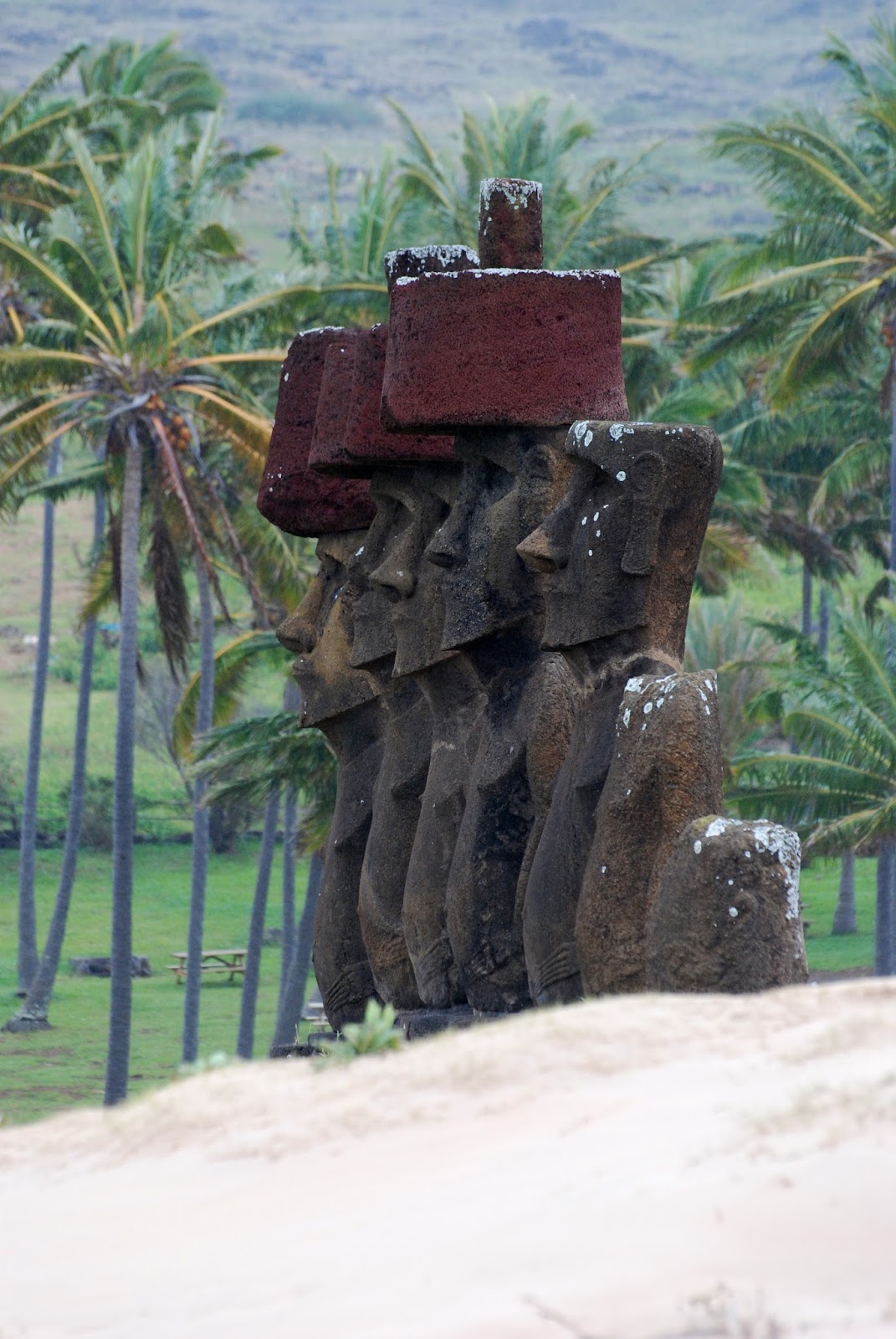
Three of the sixteen moia at the Ahu Tongariki, Rapa Nui.
Photo by Wendy Stefansson


I think it’s kind of amazing how often ancient art looks like modern art.

A few years back, on a trip to Rome, I came across the Bocca della Veritá sculpture and thought I’d stumbled upon modern art in the heart of the eternal city. The sculpture is a large stone disc depicting a man’s face, eyes wide and mouth gaping; long hair writhing. An image of terror. A brother, maybe, to Edvard Munch’s The Scream.

Turns out, it was made in the first century, and depicts (probably) a pre-Christian god.

I guess this should come as no surprise. The ancients, it seems, have inspired much of what we call modern. Picasso, for instance, was inspired by the pre-colonial masks of west Africa, by the simplification and fracturing of forms. By the blowing apart of structure in an effort to find a subject’s essence; by the leaving behind of literal appearances.

___________________________________


Last weekend, I was in Rapa Nui (Easter Island). There, I had the incredible opportunity to experience literally dozens of the moai sculptures for which the island and its culture are best known. Standing erect on their ahus (platforms), or lying face down where they were laid to rest. Or in the always-laboured process of birth at the quarry at the Rano Raraku volcano -- the newborn and the still-born -- partially submerged, partially emerging from the earth, itself newly created.

Each moai was carved to represent a king, not merely in his stature or appearance, but in his mana -- his energy or his power. The bones of the king would be contained in the ahu beneath it; the final essence of the once- and still-living ancestor. With coral eyes turned inland and with his back to the sea, the moai king would watch over and protect his people.

Ahu Tongariki. Rapa Nui.
Photo by Wendy Stefansson.

Moai scattered along the slopes of the Rano Raruku volcano.
Photo by Ariel Tarpey.

Partially-buried moai at the Raro Rakuru volcano quarry;
drowning in the liquid earth. Photo by Wendy Stefansson.


So here’s my theory. I think if we had never seen the Easter Island heads, and one (or more) was erected in New York city today, we would think it was a modern or contemporary work of art.

With its elongated proportions and now-vacant eyes, it calls to mind the paintings of Modigliani. In its blockiness, it calls to mind Brancusi’s Kiss sculptures. In its deliberate distortions -- the head almost as large as the torso, the fingers of the hands extended like knives -- it calls to mind Edward Scissorhands. Or perhaps Wolverine.

Detail of one of the moai at Ahu Tongariki. Note the long fingers below the belly.
Photo by Wendy Stefansson.


Ahu Anakena. Rapa Nui.
Photo by Wendy Stefansson 

Ahu Tongariki. Rapa Nui.
Photo by Wendy Stefansson.


In their monumental quality, their massive scale, their repetition of the same form (ancient artists working in a series), the moai call to mind contemporary approaches to sculpture.

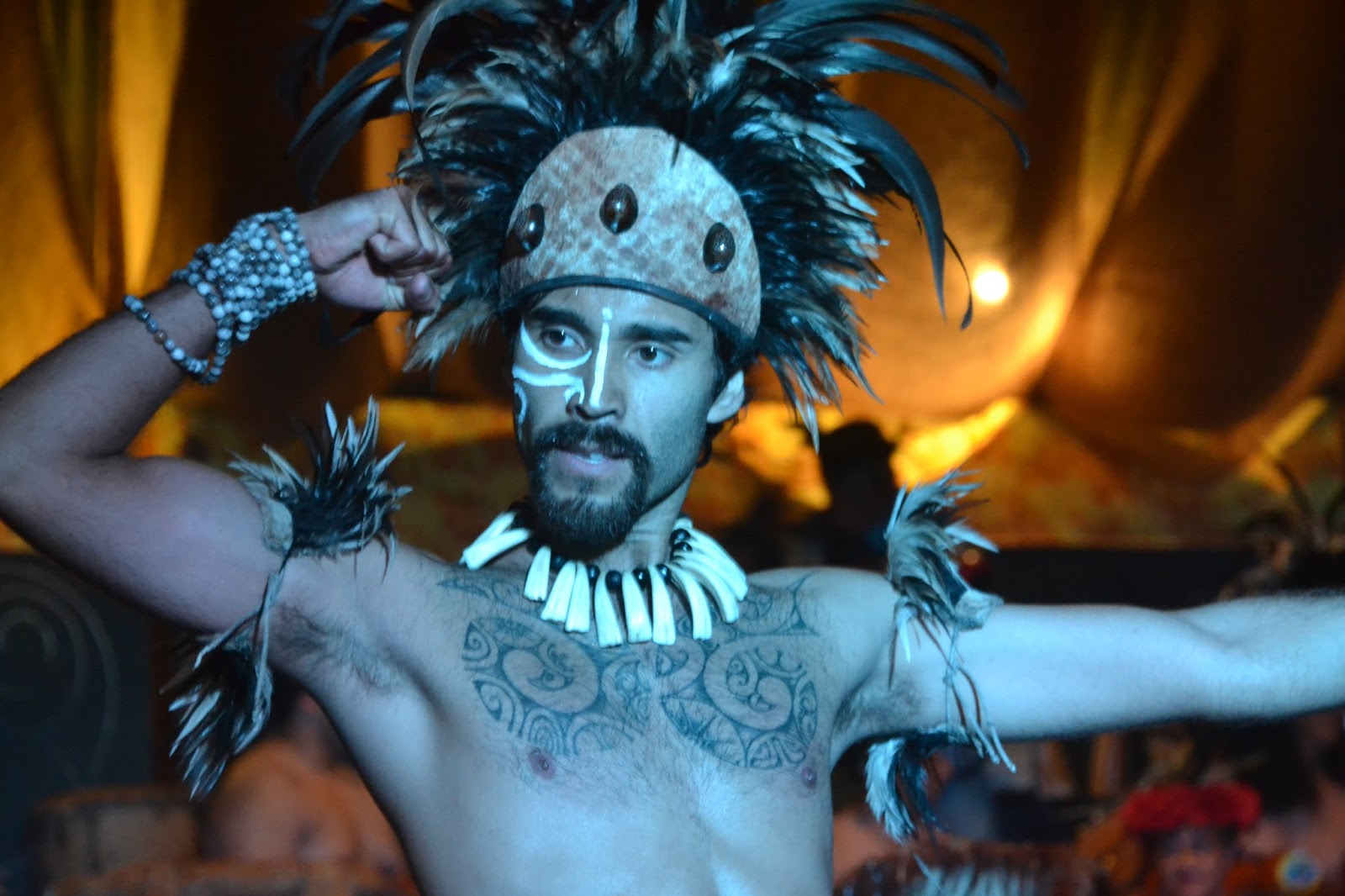
And there are other ways in which the traditional culture of the Rapa Nui contains and nourishes the seeds of the modern. The ancient Polynesians invented the tattoo, it seems. They used stretchers to elongate their earlobes, and dyed their hair candy-apple red.

I'm thinking that the moai feel right at home in the 21st century.
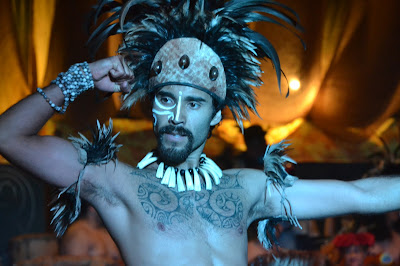

Rapa Nui dancer in traditional dress, with traditional tattoos.
Kari Kari dance performance, 27 July 2013.
Photo by Wendy Stefansson.


Wednesday, 10 July 2013

bars of steel....

Nelson Mandela sculpture by Marco Cianfanelli. KwaZulu-Natal, South Africa.
In 2012, this sculpture by artist Marco Cianfanelli was erected to mark the 50th anniversary of Nelson Mandela's arrest by the apartheid police. It is situated at the spot where he was apprehended, known now as the Nelson Mandela Capture Site. From a distance, it resembles a small forest of black, a copse of steel. But when approached from the right angle, at the right distance, it resolves into an image of Mandela.

A face rendered in bars of steel; no longer seen between or behind them.

The approach ("the long walk") to the sculpture.

Mandela sculpture by Marco Cianfanelli, unresolved.

Mandela sculpture by Marco Cianfanelli, viewed from the proper perspective.

All photos are by Scotch Macaskill ~ http://www.wildlife-pictures-online.com/nelson-mandela-sculpture.html.


Monday, 8 July 2013

vancouver, city of glass....

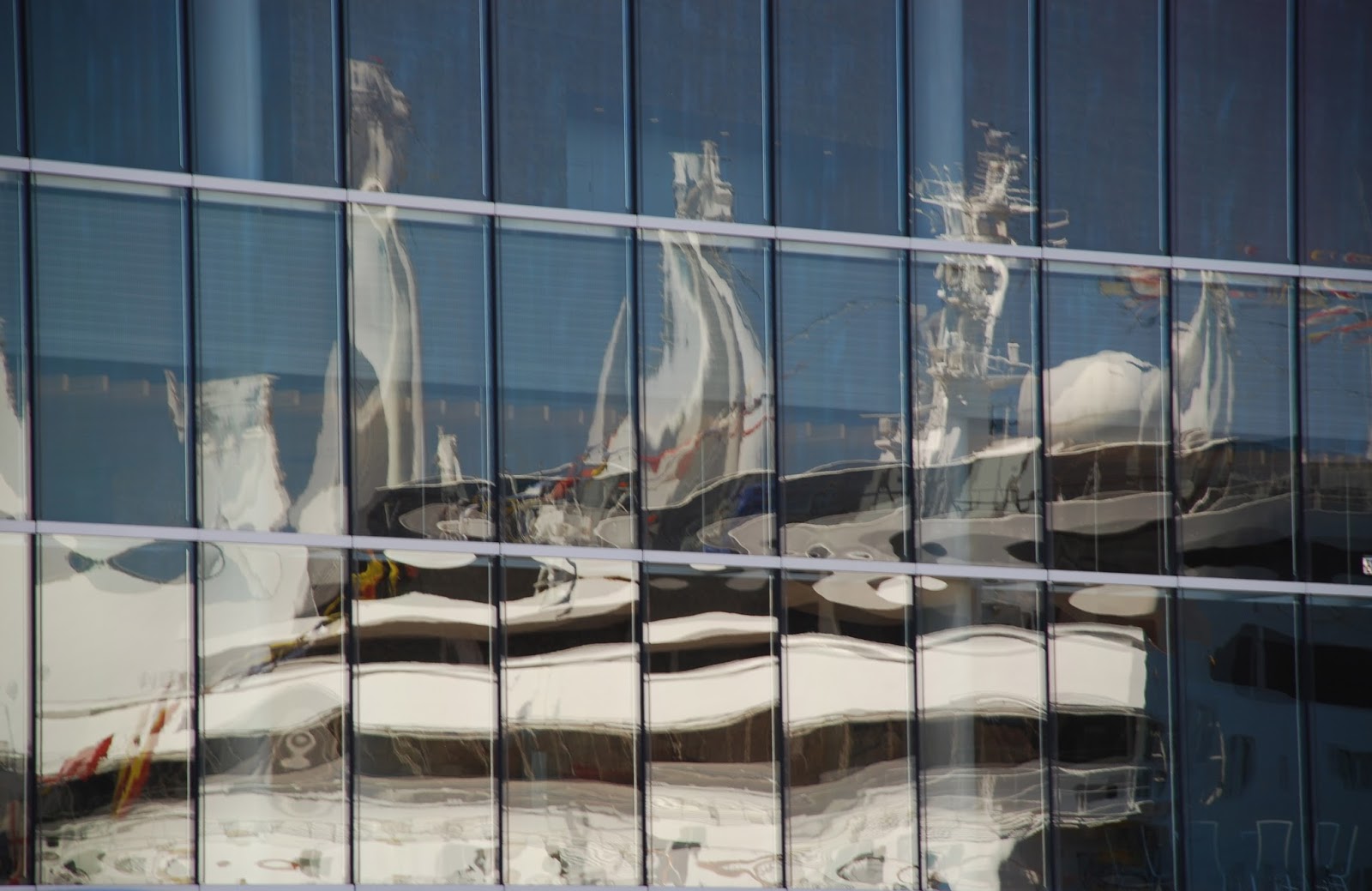
Vancouver Convention Centre reflecting the Five Sails and a cruise ship;
containing the world.

Vancouver Convention Centre reflecting the Five Sails and a cruise ship.
Olympic Flame Cauldron from the 2010 Olympics: four massive icicles
made of glass and steel. Vancouver's Coal Harbour.

Vancouver Convention Centre reflecting the Five Sails and a cruise ship;
containing the world.


All photos by Wendy Stefansson,  June 30, 2013.