pinterest button

Showing posts with label gold. Show all posts

Saturday, 24 January 2015

the void that contains....

Christian Eckart. Detail Painting 532. Gold leaf on panel, white frame.


The frame has become the art; and the wall, the frame.

The blank space outside of the art, behind the art, on which and in which the art is, has encroached onto the frame. The void contains the art; has become the vessel. The reliquary. The nothing that draws attention to the something.


M. Shartel. White/Gold Abstract. Acrylic on canvas, 2012.


Or perhaps there's been a reversal. Perhaps the gold has become the void. The figures that emerge where the ground of being ruptures. Gives way. Gives birth.

The nothing is always surrounded by the something.


god is in the details....

Christian Eckart. Detail Painting 541. 1991-93. Gold leaf on wood.


Here, at last, the frame has engulfed the painting. Consumed the painting. Become the painting.

In the hands of contemporary artist Christian Eckart, the gold leaf that is traditionally the craft of framers, that traditionally surrounds and contains the art, is the art. 

And in the process, it loses its machine-like perfection. Becomes the imperfections. The flaws. Becomes marked by the maker's hands.

It becomes the details.

Because "god is in the details." (Ludvig Mies Van der Rohe)


where the something becomes everything....


Christian Eckart. One of the Andachtsbild series on the left.
One of the Eidolon series on the right. Gold leaf on wood.


In Christian Eckart's gold works, the frame grows ever wider. From the Eidolons -- gold frames framing nothing -- to the Andachtsbilds, where the nothing is almost gone. Where the something that surrounds it, is everything. Where the something almost negates it. Almost silences it.

Where the void -- the sacred -- is almost lost.


Christian Eckhart. Two works from the Andachtsbild series. 1993


"every something is an echo of nothing"....

Christian Eckart. Eidolon #1103. 1989. 23 karat gold leaf on poplar.


The frame without a picture, framing nothing. A golden arrow, pointing to the void. 

Free-standing like a sculpture. Like a vessel. Like a figure. 

A body containing a ghost.


“Every something is an echo of nothing.”  
— John Cage


Saturday, 26 January 2013

gold

Gustav Klimt. Tree of Life. 1905


Last week I was teaching my Grade Ones about Austrian painter Gustav Klimt and his Tree of Life painting, in which a whimsical tree with spiralling branches is depicted against a background completely covered with gold leaf. I told them Klimt’s father was a jeweller, but technically he was a “gold engraver.” Engraver of what, I wondered? Pocket watches?

Of reliquaries? Chalices and patens? Tabernacles? 

Of vessels to contain God?

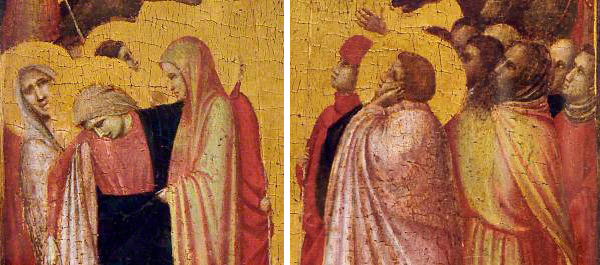
Gold, in art, always seems to be about the sacred. Think of the gold-leafed halos of saints and angels. Of the glory of God -- colour fields of luminous gold -- surrounding Mother and Child or Christ himself in Orthodox icons, in early Renaissance altar pieces, in Byzantine mosaics. Of the minute gold highlights in illuminated manuscripts, laboured over in dark monasteries; of the gilt-edged pages of Bibles. And farther back still, the gifts of the Magi.

And that’s just the Christian tradition.


Giotto. Crucifixion (detail). 1315-20.

Christ Pantocrator mosaic, Hagia Sophia, Istanbul. 12th century.

Christ in Majesty. Aberdeen Bestiary (illuminated manuscript). 1200.


So when gold appears in a contemporary work of art, is it still a signifier of what is sacred? Sometimes, yes.

In 2006, I had the great fun of sitting down across from Canadian visual artist Sarah Alford in a cafe. We talked about craft and art and Marxist politics and, at some point, gold. She introduced me to the “aesthetics of light.” 

“There is a whole western theology based on this idea that the universe is made of light in various densities,” she told me. “And the lighter things were, the closer they were to the divine. And I (Alford) thought: ‘Oh – it’s because it’s SHINY!’ (Laughter) That’s why we like it! And there’s this quality that we need and that we love. And so I just sort of took that idea out into the landscape....”


Sarah Alford. Flaws 5. Gold leaf on asphalt. 2009


Alford began gilding cracks in sidewalks, highlighting the flaws in the ground of our own making. Gracing it with gold to reflect the ground of our being.


Dorothy Cross. Relic. Shark skin and 21 carat gold. 2010.


Most recently I came across an art work by Irish artist Dorothy Cross, who was working in the Galapagos Islands. She had gold-leafed the interior of a shark skin, and called it “Relic;" a word which she may have meant solely as a reference to the shark's survival since the time before the dinosaurs. Or maybe not.

Which made me think again, that gold (in art) is often an arrow of light, pointing to the things we hold sacred.