pinterest button

Thursday, 24 November 2016

all wrapped up in it, and completely undone....

None of these photos are mine. I captured all of them from a
video posted by Gloria Franchi on youtube.com.
They accompany Leonard Cohen's song, "Dance Me to the End of Love."
They so beautifully and elegantly capture the feeling of the song.


Dance me to the end of love.

Leonard Cohen


on reference points and other fictions....


This book is not what I thought it would be. Or maybe it is.

I thought it was going to be a reflection on celebrity and fame in North American culture. I thought it would be deep and philosophical, but it’s actually very entertaining. As are celebrities.

The form reflects the content.


_______________________________________________


Don’t I Know You? by Marni Jackson is a novel written in short stories. Rose McEwan, the central character, is the axis around whom all the action pivots; and each chapter is a brief episode in her life. Also an encounter with a new celebrity.

Don’t I Know You? is deeply steeped in Canadian content. It plays with such icons of the Canadian collective psyche as loons and canoe trips; summer camps and summer cottages; campfires and campfire songs. Hudson Bay blankets. Poutine and butter tarts. Maple syrup. Hockey players hauling “corpse-sized duffel bags.”

It references such Canadian celebrities as folk singers Joni Mitchell, Neil Young, and the lesser-known Valdy. Canadian writer Margaret Atwood. Canadian painters Tom Thomson and the Group of Seven. Actor/comedian Dan Aykroyd. CBC radio host Shelagh Rogers. And the forever uncategorizable Leonard Cohen.

It’s set in Algonquin Park and big-city southern Ontario. Oh, and Greece. And Mexico. And Cannes and Taos. And Dublin.

Okay, so the content is not exclusively Canadian. Borders here are unguarded. American celebrities are allowed entry without visas — Bob Dylan, Taylor Swift, John Updike, Meryl Streep, Gwyneth Paltrow — as are the Irish and the British, and at least one Norwegian.

But a lot of the references are Canadian. And it’s always fun to “get” the references.


______________________________________________


And maybe that’s the thing about using celebrities as characters. We get the references. 

They come to us ready-made. Prêt-à-porter. They are reference points in the known universe. They are the compass points of the common culture.

They are already works of fiction; and ones we feel like we know.


_______________________________________________


In 1917, visual artist Marcel Duchamp signed a urinal as “R. Mutt” and submitted it under the title of Fountain to the Society of Independent Artists in New York, who refused it for their exhibition. But Fountain went on to become one of the most important works of art of the twentieth century. It introduced the concept of the “readymade” in art: using existing manufactured or found objects to signify. To mean something. To enlighten or maybe to entertain.

“Readymades” opened doors onto collage, assemblage, and installation art; in which using a pre-existing object as part of a composition brings the meaning of that object into the work — its history; its materiality; its uses. The memories and associations we attach to it. And I think that is what Jackson is doing in a literary form with Don’t I Know You?

Joni Mitchell, for instance, comes to the reader readymade. We know who she is. We know her voice. We know her long, blonde hair and peasant skirts. We know her lyrics. We understand the context of her life, coming of age in the “free love” ethos of the 1960s. We can almost smell the patchouli oil. All of that context comes into Jackson’s story with the mere mention of Mitchell’s name. The reference.

Jackson deconstructs the lyrics from Mitchell’s song, "Carey," and uses them as context for a young, far-from-home Rose McEwan. The backstory for Rose’s misadventures living among hippies in Matala — going on down to the Mermaid Cafe and buying a bottle of wine — is pre-existing in the song. The song packs setting, characters and zeitgeist into a short story with unembellished economy.

Similarly, Jackson imports a youthful Neil Young, his father, and the unnamed foreman from Neil’s ranch to unpack the readymade lyrics of “Old Man;” to tell a short story about a long relationship. 

In another story, Van Morrison transports Rose (by bus) “into the mystic.” Or at least to Cyprus Avenue. 

Bob Dylan goes tubing on a lake with Rose’s teenaged son, reliving the innocence and experience of his summer camp days in Madawaska.

Leonard Cohen brings her tea and oranges

________________________________________________


But readymade characters can be fictionally decontextualized, and — arbitrarily, capriciously — re-contextualized. For instance, Jackson juxtaposes Leonard Cohen and Taylor Swift in the final story of the novel, casting them among a short and improbable list of characters (including Rose) who venture out on a canoe trip together.

You don’t have to know much about either of these musicians to know they couldn’t be more different. Old and young, male and female, bass and soprano, measured and manic. She is the lightning to his thunder. And in the “Mississippi’s” that you count between the light and the sound, a new context is created. A time in which anything could happen. A space for an unlikely conversation.

In that space and in that moment, shaped and defined by fictional, cultural reference points, Rose finds the story she is meant to tell.

“‘The story begins not far from here,’ [she] began.” (page 239)


Wednesday, 16 November 2016

on small (and sometimes big) acts....


Dead Horse Bay is a short documentary produced for ABC News by Robin Nagle, Anthropologist in Residence for the New York City Department of Sanitation. It first aired on April 3, 2016. It's about a historic landfill site and contemporary national park in New York City. The following blog post is made up of my somewhat random responses to this video.


Beaches and treasure; they’ve always been linked.

I have spent my whole life walking repeatedly on the same short stretch of beach, and picking things up. (A sort of ritual; a meditation; a labyrinth, taking me closer and closer to myself. To my origins. To my source.)

My favourite thing to pick up has always been blue beach glass. Beautiful garbage. Small shards of human history.

The beach as reliquary; as midden; as a place where treasures are still buried (and unburied).


____________________________________________________


Crowd sourcing.

At first it was for small, personal acts of charity. Helping to finance a person’s medical care that wasn’t going to be covered by insurance. Helping to pay the legal fees of someone who’d been wronged. Helping to finance a family whose home had been destroyed. Helping to fill gaps and right wrongs. (Refugees starting over and the displaced trying to get back home.) Sticking one’s finger in the dike where governments and insurance companies and banks were failing. Filling the gaps in the financial infrastructures with small (and sometimes big) acts of humanity; of compassion.

But then crowd sourcing quickly became about funding people’s private aspirations and ambitions. And I have to admit, I thought: why should I give money so that another person could make money? That’s what banks are for. That’s what stock options are for. That’s what the Dragon’s Den and the Shark Tank are for.

On one level, we have always funded other people’s dreams and ventures. That’s the unwritten contract on which capitalism is based. The consumer supports the producers, the manufacturers, and the distributors with the choices they make in how they spend their money. With small (and sometimes big) acts of consumption.

And this is where it gets interesting. Crowd sourcing has democratized money and opportunity in ways we are still imagining. It puts the average person in the position of making decisions about the kinds of ventures they want to support. It gives people with even a small amount of money the opportunity to shape and influence the world they live in. It creates a sort of natural selection process for organizational start-ups and aspirations. And it could potentially be a game changer. An alternative vision.

What if?

What if we decided to fund the things that were important to us? What if we decided to use our small stashes of money to back somebody whose ideas and initiatives could really make a difference to us? What if those choices turned out to be different from the choices made by the people who think they call the shots? The old boys’ networks? The Dragon’s Dens?

What if we used our money to support things that don’t even make money?


___________________________________________


We do it every day.

Capitalists make the mistake of thinking that people are motivated solely by money; and as a society we have accepted this diminished view of ourselves. That each of us can be defined by our role within the mechanisms of production and consumption. That anything of value can be bought and paid for. That “value” and “cost” are synonymous.

And perhaps they are.

The things that are of the greatest value to us are the things that cost us. Not the things that pay us. The things that we are willing to take risks for; not the things that keep us safe. The things that we are willing to spend/expend for. (Time, energy, money….) To give-up for. To lose for; not to win. To be diminished. To be depleted. To be scarred for.

To become less for.

Our small (and sometimes big) acts of faith.


Sunday, 23 October 2016

a work in two (or more) parts...

Edwin Timothy Dam and Veronica de Nogales Leprovost.
In Scope. Bronze. 2015, Edmonton, Alberta Canada.
This work is situated outside the Li Ka Shing Centre for Health Research
at the University of Alberta.


Part architecture, and part figure.

Part door, and part window.
Part frame.
Part device to look through;
and part the one who does the looking.
Part the view that is bounded by the box.
Part the one who looks within, and finds nothing
and everything.
Part the one seeking,
and part the one finding.


Edwin Timothy Dam and Veronica de Nogales Leprovost. In Scope.

Edwin Timothy Dam and Veronica de Nogales Leprovost. In Scope.


Saturday, 22 October 2016

a cautionary tale...

Steve Driscoll. These Are Truly the Last Days.
Industrial urethane on panels, water (dyed black), wood, rock. 2016
Photo by Finn O'Hara, www.probertsongallery.com


At the entry, there is a sign. It cautions you. (A cautionary tale.) (Perhaps every art show should have one.)

It warns that the exhibit contains real water, and asks you to stay on the boardwalk and the stepping stones.

You walk into what looks and feels like a quintessentially Canadian landscape. Dark waters under night skies, a dock, some rocks. And light.

High gloss paintings that contain layers of light. Aurora and nebulae. Constellations. Each reflecting in the other; skies in waters, waters in skies. One sky in another.

Every surface implies a depth. Every light is a hole in the darkness. Star-spattered sky-fields reflect in water rippled almost imperceptibly by our breaths, our footfalls. Our existence.

The silence of the universe, and we at the centre of it; almost unnoticed. Inconsequential.

(A cautionary tale.)


Steve Driscoll. And a Dark Wind Blows.
Industrial urethane on panels, black (dyed) water, rock, wood. 2016


#stevedriscoll
#peterrobertsongallery
www.probertsongallery.com


Tuesday, 13 September 2016

walking backwards....


The following is my response to Yann Martel's  The High Mountains of Portugal.


A young man walks backwards through the streets of Lisbon. Looking backwards at what he had, what he was. What he has lost: his lover, his son. But moving inexorably forward.

It’s 1904.

[Elsewhere. Another time, another place. The young men who fought the so-called Great War rise up and walk backwards, to their homes, to their families. They are resurrected.] (1)

The young man — Tomás is his name — has never been in an automobile before. He is instructed to turn the steering wheel to the right to turn the car to the right. Turn it to the left to go left. But he’s puzzled. If the top of the wheel is going towards the right, the bottom is going to the left. At the right side, it is arcing downwards. At the left, upwards. How can a circular motion be described in linear directions?

[Elsewhere. Another time, another place. People believed the planet was flat. They drew flat maps, with dangerous places at the edges.]

To turn the car to the right [a quarter of a turn on a spinning planet orbiting a star] you turn the steering wheel clockwise.

[Such a curious direction: “clockwise.” Turning in the direction of time. The direction of the stars, the directions of prayers. Elsewhere. Another time, another place.] (2)

[Or “counter-clockwise.” Against time. Undoing time. Looking to the past. Moving/walking backwards.]

[But of course, the direction of the hands on a clock depends on where you are standing. From inside the clock, the clock runs backwards.] (3)

[Elsewhere. Another time, another place.]


The clock at the Musée d'Orsay in Paris, from the inside looking out.
Photo credit to Joe Vlad, the blogger.
https://joevladineurope.wordpress.com/2012/03/19/


_______________________________________________________________________


The young man — Tomás is his name — journeys in an automobile, north from Lisbon into the “high mountains of Portugal.” He moves from the city — the modern human habitat — back to the country where the amenities are few and primitive. He retraces the human journey: from the urban, to the agrarian, to the wild. 

As he moves across the earth he loses himself; he loses his humanity. He loses all regard for outward appearances, even the pretence of cleanliness. He becomes filthy. He stinks. He becomes infested with lice. He scratches himself raw. He douses himself with moto-naphtha. He catches on fire. He is naked, injured, and alone in the middle of nowhere, in a state so vile he is barely recognizable. Not that there is anyone there who would recognize him anyways. He has reached the farthest edge of human existence.

And then he finds what he is looking for. The next step backwards in time; in the human journey. The ape. The chimpanzee.

On a cross, lifted up. Resurrected.

Because going backwards in time is always about resurrection. Re-animating the dead. Finding the lost. [Elsewhere. Another time, another place.] 

Unless it’s about origin.

When we look back in time, we find, “Not a god — only an animal.”(4) This is our origin story.

______________________________________________________________________


An older man — Eusebio is his name — is visited in his office late at night by an even older widow. Eusebio is a coroner. The widow has brought him the body of her husband.

Upon opening the body, he finds that it, in turn, contains the body of a chimpanzee. The body contains all that it has ever been; its entire genetic code.

_______________________________________________________________________

[Another time, the same place.]

An even older man — Peter is his name — adopts a chimpanzee to fill the empty space left in his life  by the death of his wife. He unwittingly retraces Tomás’s journey, ending in the high mountains of Portugal, taking the chimp with him.

He leads the chimp backwards to the beginning of the human journey. To the wild place where human and ape divided. To the place where their separate destinies converge back into a common origin.

Then the chimp leads Peter. He takes him to a tall standing rock; to the very top of it. 

Both man and ape peer over the edge of the known, and into the mythic. Into the mystic. Into the world as it was before our origins. They have reached the centre of the clock where time can pivot in both directions. The “still point of the turning world.” (5) The black hole at the centre of the universe. The place where the beginning inhabits the end.

[Every time. Everywhere.]


Notes:

(1) As seen in the frame story created by David Fincher for the film version of The Curious Case of Benjamin Button. A mysterious clock-maker is commissioned to make a clock for a train station in New Orleans. When it is finished, it is revealed that the clock runs backwards. The maker claims that this was so that we could “turn back time,” so to speak, and our war dead would rise from their graves and sail backwards across the ocean to come home.

(2) Tibetan Buddhists have prayer wheels — cylindrical spindles containing papers with prayers written on them.“The practitioner most often spins the wheel clockwise, as the direction in which the mantras are written is that of the movement of the sun across the sky.” — https://en.wikipedia.org/wiki/Prayer_wheel

(3) There is a photo which has been taken many, many times, of the view of Paris from the upper floor of the Musée d’Orsay (formerly the Gare d’Orsay; a train station). The viewer looks out through the glass walls of a large clock. From that vantage point, the hands of the clock appear to be running backwards.

(4) Yann Martel. The High Mountains of Portugal. Page 129.

(5) T.S. Eliot, from the poem, “Burnt Norton.”

“At the still point of the turning world. Neither flesh nor fleshless;
Neither from nor towards; at the still point, there the dance is,
But neither arrest nor movement. And do not call it fixity, 
Where past and future are gathered. Neither movement from nor towards,
Neither ascent nor decline. Except for the point, the still point,
There would be no dance, and there is only the dance.”


Wednesday, 7 September 2016

a (mostly) bloodless violence....


Carey Newman. Witness Blanket (installed at
Peace River Museum and Archives). 2016


“The blanket is a universal symbol of protection. 
For many of us, it identifies who we are and where we’re from – we wear them in ceremony and give them as gifts. 
Blankets protect our young and comfort our elders.”


When I first heard about the Witness Blanket — an art installation assembled by First Nations artist Carey Newman — I assumed it referenced the blankets given to Aboriginal peoples which were infested with the smallpox virus. But that was not it. Small pox was a much earlier tragedy; an earlier genocide.

The Witness Blanket is about the tragically recent (the recently tragic) history of residential schools. From 1870 until 1996, there existed in Canada residential schools for First Nations, Metis and Inuit children. Typically run by churches, they were created by a government explicitly looking to “Take the Indian out of the child.” Children as young as 5 were forcibly removed from their homes, moved great distances to attend schools, then barred from speaking their own languages, participating in their own cultures, seeing their own families and communities. A (mostly) bloodless violence, that nonetheless destroyed tens of thousands of lives.

But you knew that.


Carey Newman. Witness Blanket (detail)


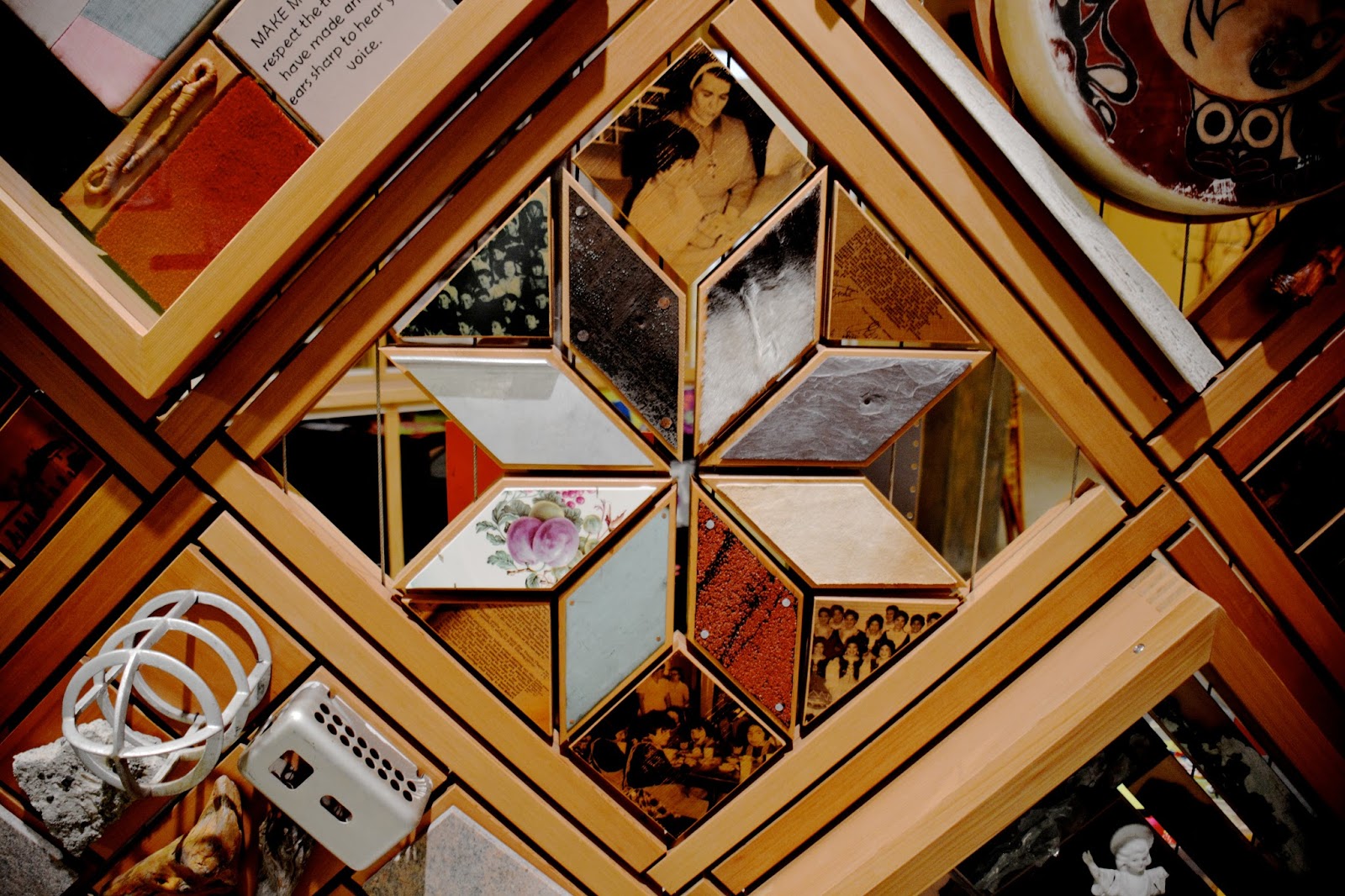
In the Witness Blanket, Newman uses material objects to tell the stories of residential schools. Taking debris that might otherwise be landfill, and raising it to the status of evidence; from remnant to relic. Assembling these objects into a "quilt," each panel made out of previously used things; things steeped in memories. The scraps of human existence — of a particular time, and a particular place. A particular genocide.

Like a quilt, each section has a border; the borders made of wood. Wood like the walls of churches and schools, the structures and the institutions made to incarcerate the innocent and the unduly orphaned.

And like a quilt, the panels employ a strict geometry to create a sense of order. Rectangles, squares, rhombuses, triangles; eight-pointed stars. Crosses or Xs. Horizontal, vertical, diagonal. Straight lines. It’s mathematics imposed on memory, giving it structure. Giving it order. Trying to make it make sense.

All of it mounted on top of leather-bound books of Canadian law.

Carey Newman. Witness Blanket (detail)

At the top left, just where you would start to read if the work were a page, a little girl’s face appears in the centre of a cross-section of a tree; the heart wood; the heart missing, the missing piece of a parent’s heart. The wood is from an apple tree that grew on the premises of one of the residential schools. The apple tree, ostensibly the Tree of the Knowledge of Good and Evil; knowledge which it is surely (and ironically) the purpose of churches and schools to impart. But also the bearer of a fruit which is “red on the outside, white on the inside;” an "apple" being a derogatory term sometimes used by Aboriginal people to describe one of their own who is deemed to be too white, or not Native enough. The creation of which was also, surely, the purpose and the legacy of residential schools.

Around the outside of the tree slab, there are two thick, glossy, black braids of hair mounted in a broken circle. (“Will the circle be unbroken, by and by Lord, by and by?”) The braids that signified to the children their culture and tradition; their identity and their belonging. That very literally contained their DNA; their ancestry, their heritage, their genetic codes.


Carey Newman. Witness Blanket (detail).


This panel is enclosed behind glass, like a trophy case. And here’s the thing. Glass always shows you who you are; windows are also mirrors. So I inadvertently become a part of the piece; left wondering who I am. My face reflecting over the little girl’s, but larger, oppressive. I become the oppressor. I have to wonder about my complicity. About my role, with the big black voyeuristic eye of my camera; witnessing.


“No adult of sound mind, can be an innocent bystander….
This is my trouble --
These were my fathers.
So how am I supposed to feel,
Way out on the rim of the broken wheel?”

Bruce Cockburn, Broken Wheel, 1981


Carey Newman. Witness Blanket (detail)


In another panel, another little girl. This one a ceramic angel. Her glaze is crackled, and she is missing an arm. The other arm has been glued back in place. Her lost arms signify, perhaps, her lost agency. Her helplessness. She has been disarmed and disabled. She is unable to act on her own behalf.

She is surrounded by burnt wood, melted glass, and scraps of shingles from the burning of the residential school in Norway House. A photo of the burning school is mounted behind her. She is broken, the school is broken, the system is broken.

This panel is a study in brokenness.

Carey Newman. Witness Blanket (detail)


So, too, is a panel which contains chunks of concrete, literally the crumbling foundations of various schools and churches. To me, they look just like the bits of the Berlin Wall my husband brought home from Germany in 1990.


Left: Carey Newman, Witness Blanket (detail).
Right: Bill Reid. The Black Canoe: Spirit of Haida Gwaii. Bronze.


Nearby there is a panel which contains a Canadian $20 bill. The bill bears the image of Bill Reid’s iconic Black Canoe, a massive sculpture of a group of west coast First Nations totems in a boat -- a sort of deconstructed totem pole. It is couched between phrases from a well-known Ojibway prayer.


“Make me ever ready to come before you
with clean hands and a straight eye,
So when life fades, as the fading sunset
My spirit may come to you without shame.”


The image is one of crossing over, or perhaps of escape. Perhaps, in some cases, these are the same thing.


Drawing by George Littlechild. Priest and His Prey.


But the darkest piece of the Witness Blanket, I think, is the door in the middle of it. On one side of it, there is a drawing by First Nations artist George Littlechild. It depicts a large male face hovering ominously above the face of a sleeping child. At the bottom, there are small, black handprints.

Carey Newman. Witness Blanket (detail)


This door is never to be closed again.


SaveSave